
November 19, 2026
When an Edmonton rental property becomes vacant, the immediate priority is usually finding someone suitable to move in. You need to advertise the property, respond to enquiries, arrange showings, assess applications, prepare the lease and get everything ready for the new tenant.
That is already a considerable amount of work. It is understandable why a landlord might want professional help with the process.
But there is another question worth answering before you hire anyone: Do you need help finding a tenant, or do you need someone to manage the property after the tenant moves in?
These are two different services, even though they overlap during the leasing process.
Tenant placement is generally a one-time service that takes a rental property from vacancy to an occupied tenancy. Full-service property management goes further. It covers the ongoing work involved in collecting rent, communicating with tenants, coordinating maintenance, managing lease matters and looking after the property’s day-to-day operations.
The right choice depends on how much responsibility you want to retain as the landlord. Understanding where one service ends and the other begins can help you avoid paying for support you do not need, or taking on responsibilities you are not prepared to manage.
What Does Tenant Placement in Edmonton Actually Cover?
Tenant placement is a leasing service designed for property owners who want professional assistance finding and securing a tenant but intend to manage the property themselves afterward.
Think of it as bringing in a specialist to handle the process of filling a vacancy.
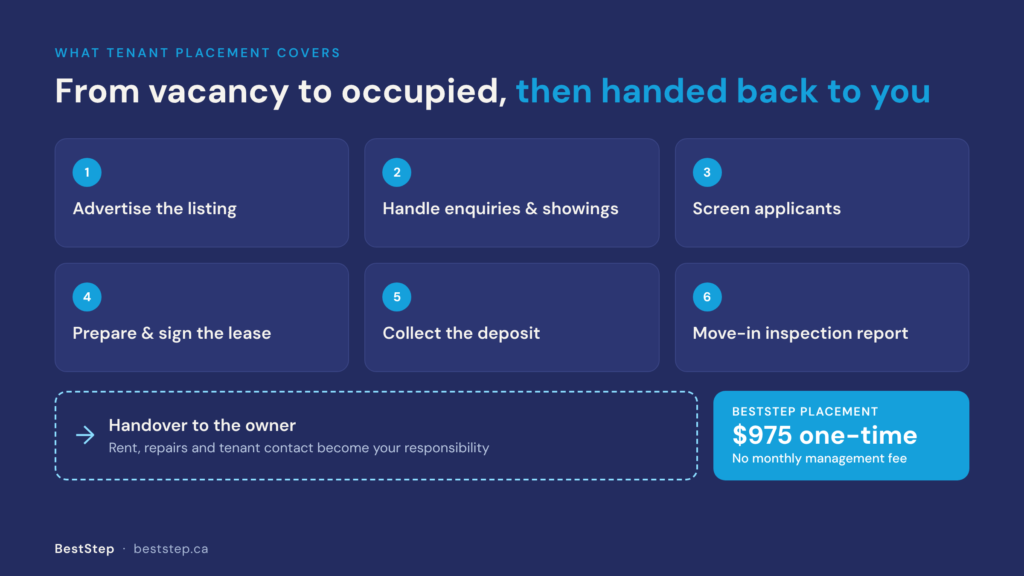
Depending on the provider, tenant placement services may include:
- Preparing and advertising the rental listing.
- Responding to enquiries from prospective tenants.
- Arranging and conducting property showings.
- Reviewing applications and screening prospective tenants.
- Checking relevant credit, income and rental references.
- Preparing and executing the tenancy agreement.
- Collecting the security deposit.
- Completing a move-in inspection report.
- Handing over the tenant information and relevant documents to the property owner.
The objective is to give the landlord a properly established tenancy without requiring them to handle every part of the leasing process personally.
For example, an owner in Edmonton might have a rental property ready for occupancy but not want to spend evenings answering listing enquiries, arranging viewings or following up with applicants. They may be perfectly comfortable collecting rent, communicating with the tenant and coordinating repairs once someone moves in.
A tenant placement service allows that owner to outsource the initial leasing work while retaining control of the ongoing landlord-tenant relationship.
What does Best Step’s tenant placement service include?
Best Step offers a standalone tenant placement service for property owners who want professional help finding and securing a tenant without committing to ongoing monthly management.
The service covers digital advertising and property marketing, virtual and in-person showings, tenant screening, lease preparation and execution, security deposit collection, and a photographic move-in inspection report.
Best Step’s advertised screening process includes checks involving credit, income and landlord references. Once the lease has been signed, the deposit collected and the move-in inspection completed, the tenant relationship is handed back to the owner.
The service is currently listed at a one-time flat fee of $975, with no monthly management fee attached to the placement arrangement.
That distinction matters. The fee covers the tenant placement process, not the day-to-day management of the property for the duration of the tenancy.
You can see the full scope of the service on Best Step’s Tenant Placement page.
What Happens After the Tenant Moves In?
This is the most important part of the decision, and it is where landlords need to pay close attention.
A successful tenant placement does not mean the work of being a landlord is finished. It means the property has moved from the leasing stage into the management stage.
Once the tenant moves in under a placement-only arrangement, the owner takes responsibility for the ongoing relationship. That includes several responsibilities that can continue throughout the tenancy.
Rent collection: Someone must monitor rent payments, follow up when payments are late, maintain payment records and address any outstanding balances.
Tenant communication: The tenant may have questions about the property, the lease, utilities, access or other matters. The landlord becomes the person responsible for responding and following up.
Repairs and maintenance: A tenant may report a leaking tap, a heating problem, an appliance fault or a more urgent maintenance issue. The owner must arrange the appropriate response and ensure the property remains in good condition.
Lease administration: Changes to tenancy arrangements, renewals, notices and other lease-related matters require attention. The landlord must understand what the agreement permits and what Alberta’s tenancy rules require.
Inspections and property condition: The owner must keep track of the property’s condition and arrange the appropriate inspections and documentation.
Move-out and the next vacancy: When a tenant leaves, the owner must manage the move-out process, assess the property’s condition, deal with the security deposit and prepare for the next tenancy.
These responsibilities do not disappear because a professional company helped find the tenant.
Alberta’s Residential Tenancies Act establishes obligations that continue throughout a tenancy. For example, landlords are responsible for keeping rental premises reasonably safe and in good repair, not simply ensuring the property is ready on move-in day. Alberta also requires both move-in and move-out inspection reports. If the required inspection reports have not been completed, a landlord cannot deduct cleaning or damage costs from the security deposit.
You can review the requirements in the Government of Alberta’s guidance on what happens during a tenancy and landlord and tenant rights and responsibilities.
This is why the handover matters so much. A move-in inspection report documents the property’s condition at the beginning of the tenancy. It does not provide ongoing maintenance, rent collection or tenant support.
Before choosing tenant placement, a landlord should be comfortable taking responsibility for everything that follows.
What Does Full-Service Property Management in Edmonton Include?
Full-service property management is an ongoing arrangement in which a professional property management company looks after the operational side of the rental property.
Rather than handing the tenant relationship back to the owner after the lease is signed, the management company remains involved throughout the tenancy.
The exact scope depends on the management agreement, but full-service management commonly covers:
- Marketing vacant properties and securing tenants.
- Collecting rent and monitoring payment activity.
- Managing tenant enquiries and communication.
- Administering leases and coordinating renewals.
- Arranging routine and preventive maintenance.
- Responding to urgent maintenance issues.
- Coordinating contractors and service providers.
- Conducting property inspections.
- Addressing tenant complaints and disputes.
- Providing financial statements and property performance information.
- Supporting the landlord with relevant tenancy documentation and processes.
The difference is that the property owner is no longer responsible for coordinating every recurring task personally.
Consider a tenant who reports that the heating system has stopped working in the middle of winter. Under a placement-only arrangement, the owner must receive the report, determine the next steps, contact an appropriate service provider and follow up until the issue is resolved.
With full-service management, the property manager becomes the day-to-day contact for that issue and coordinates the response within the authority provided by the management agreement.
The same applies to rent collection, routine tenant communication, maintenance requests and other operational matters.
How Best Step approaches full property management
Best Step’s broader property management service covers the ongoing responsibilities that fall outside its standalone tenant placement arrangement.
Its listed services include rent collection, lease management and renewals, property inspections, emergency response, routine and preventive maintenance, financial reporting, move-in and move-out inspections, security deposit support and issue resolution.
Best Step also describes full property management as including ongoing rent collection, 24/7 maintenance calls, tenant disputes and financial reporting.
For an owner who wants to retain the investment while delegating the recurring work involved in operating the rental, this provides a different level of support from simply finding a tenant.
You can explore the broader scope on Best Step’s property management services page.
Tenant Placement vs. Full Property Management: What Is the Difference?
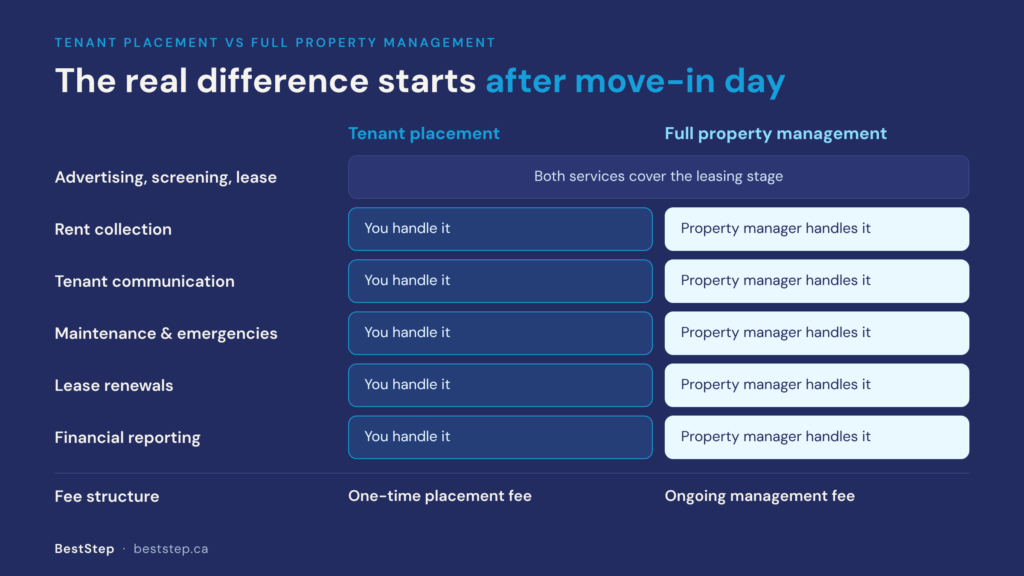
The easiest way to compare the two services is to look at what happens before and after a tenant takes possession.
| Area of responsibility | Tenant placement | Full property management |
| Property advertising | Included in the placement process | Handled as part of securing a tenant |
| Showings and enquiries | Managed during leasing | Managed during leasing |
| Tenant screening | Included in the placement process | Included in the leasing process |
| Lease preparation | Included in the placement process | Included in the leasing process |
| Security deposit | Collected as part of the placement process | Managed within the ongoing service arrangement |
| Move-in inspection | Included in Best Step’s placement service | Included within the broader management service |
| Rent collection after move-in | Owner’s responsibility | Managed by the property manager |
| Tenant communication | Owner takes over after handoff | Property manager handles day-to-day communication |
| Maintenance requests | Owner coordinates the response | Property manager coordinates the response |
| Emergency maintenance | Owner arranges the response | Handled through the agreed management process |
| Lease renewals | Owner manages them | Included in the broader management scope |
| Financial reporting | Owner maintains their own records | Property manager provides reporting |
| Fee structure | One-time placement fee | Ongoing management fee |
The distinction is not simply that one service costs less than the other. They cover different amounts of work.
With tenant placement, the owner pays for a defined leasing assignment and takes over the ongoing responsibilities. With full-service management, the owner pays for continuing operational support.
It is important to compare the actual service agreement rather than assume every company includes the same activities. Ask which services are covered, what attracts additional charges and what decisions still require your approval.
When Does Tenant Placement Make More Sense?
Tenant placement is a sensible option when the landlord has the time, capacity and resources to manage the property once it is occupied.
You may not need a full-service property manager simply because you do not want to handle the process of finding a tenant yourself.
There are several situations where a standalone placement service may be sufficient.
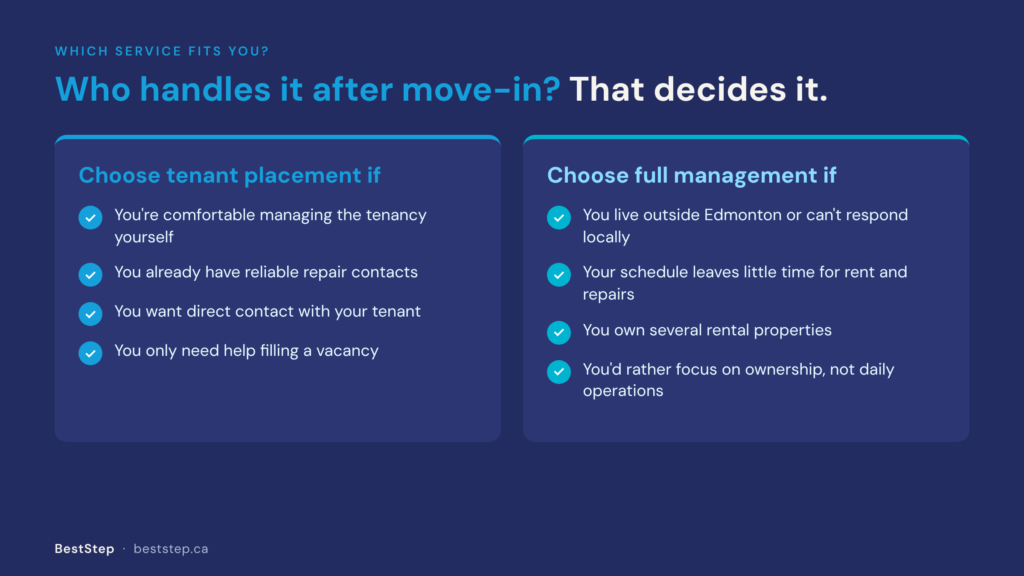
You are comfortable managing the property yourself.
Perhaps you already have experience as a landlord. You understand rent collection, tenancy agreements, maintenance coordination and tenant communication. Your main challenge is finding and securing a suitable renter.
In that situation, paying for professional leasing assistance can remove a demanding part of the process without changing how you operate the property afterward.
You already have reliable maintenance support.
Some landlords have established relationships with plumbers, electricians, appliance technicians and other service providers. They know who to contact when something needs attention and can coordinate repairs without much difficulty.
If the maintenance side is already organised, full-service management may offer more support than they currently require.
You want to maintain direct control of the tenant relationship.
Some property owners prefer to communicate directly with their tenants, oversee the property themselves and make operational decisions without involving a third party.
Tenant placement gives them professional assistance at the point where they need it most, while allowing them to retain that direct relationship.
You only need help filling a vacancy.
An owner may have managed a property successfully for several years but need assistance finding a replacement tenant after the previous one leaves. The need for professional support may be temporary rather than ongoing.
In each of these situations, the important condition is that the owner is genuinely prepared to take over after the tenant moves in.
When Is Full-Service Property Management the Better Choice?
Full-service management becomes more valuable when the owner does not want to be responsible for the recurring work involved in operating the property.
This may be because of limited time, distance, the number of properties involved or simply a preference for a more hands-off investment.
You live outside Edmonton or cannot respond locally.
An owner living in another Alberta city, another province or outside Canada may find it difficult to know how much to charge for rent, coordinate repairs, respond to tenant concerns or attend to property matters when they arise.
Having a professional management company on the ground can provide the operational support that a remote owner would otherwise have to arrange independently.
Living outside Edmonton does not automatically mean you need full management. An owner with a dependable local representative may still be able to manage a property after using a placement service. The real question is whether someone can reliably handle the responsibilities when they arise.
Your schedule leaves little room for property management.
A rental property can generate work at inconvenient times. Rent may arrive late, a tenant may need assistance or an urgent repair may require attention outside normal working hours.
If your professional or personal commitments make it difficult to respond consistently, delegating those responsibilities may be the more practical arrangement.
You own multiple rental properties.
Managing one rental is different from coordinating several properties, each with its own tenants, lease dates, maintenance needs and payment records.
As a portfolio grows, the amount of administration can increase. A management company can provide a more structured way to coordinate these activities and keep records across the properties.
You want to focus on ownership rather than daily operations.
Some landlords are comfortable making investment decisions but have little interest in managing tenant requests, following up on rent or coordinating contractors.
They want to remain involved in important property decisions without becoming the person responsible for every operational detail.
Full-service property management is designed to support that arrangement.
How Should You Compare the Cost of Both Services?
It is tempting to compare a one-time tenant placement fee with the monthly cost of full property management and choose whichever appears cheaper.
That comparison can be misleading because the two arrangements transfer different amounts of work.
With tenant placement, you pay a one-time fee for the leasing process. Afterward, you remain responsible for rent collection, maintenance, tenant communication, lease administration and other ongoing duties.
With full-service management, you pay an ongoing fee for the management company to handle the agreed operational responsibilities.
A more useful comparison considers the total cost of each arrangement over the period you expect to own and rent out the property.
For a placement-only service, consider:
- The one-time tenant placement fee.
- Your time spent handling rent collection and tenant communication.
- The cost of arranging and supervising maintenance.
- Whether you have reliable local contractors and emergency support.
- The time required to manage lease renewals, inspections and future vacancies.
For full-service management, consider:
- The monthly management fee over the expected tenancy period.
- Whether tenant placement attracts a separate charge.
- Which maintenance and administrative services are included.
- Whether there are additional charges for specific services.
- How repair approvals and expenditure limits are handled.
- What financial reporting and communication you receive.
The value of full-service management is not limited to the tasks it removes from your schedule. It also gives the property a more organised operating arrangement, provided the management company has clear processes and performs the agreed work.
On the other hand, there is little reason to pay for ongoing management if you have the time, systems and willingness to handle those responsibilities yourself.
The best option is the one that makes sense for the actual way you intend to operate the property.
What Should You Check Before Hiring a Tenant Placement Service?
If you decide that tenant placement is the right fit, the next step is to understand exactly what the provider will do before handing the property back to you.
A low one-time fee is not enough to establish whether a placement service offers the support you need.
Start with the screening process. Ask what information is reviewed, whether income and rental references are checked, how credit checks are handled and how applicants are assessed. A professional screening process should use relevant criteria consistently rather than relying on assumptions about prospective tenants.
There are also legal considerations. Alberta’s Personal Information Protection Act governs how landlords handle the personal information of prospective and current tenants. The Office of the Information and Privacy Commissioner of Alberta’s landlord guidance explains that landlords should collect only information reasonably required for the tenancy decision and obtain consent before requesting a credit report. Alberta’s Human Rights Commission guidance on rental housing also explains the obligation not to discriminate when advertising rental housing, reviewing applications or selecting tenants.
Beyond screening, ask the provider:
- What does the advertised fee cover? Confirm whether marketing, showings, screening, lease preparation, deposit collection and the move-in report are all included.
- How is the final tenant selected? Understand how applicants are assessed and what role you have in the approval process.
- Who prepares and signs the lease? Clarify the parties to the agreement and how the tenancy terms are established.
- How is the security deposit handled? Confirm how it is collected, documented and transferred or held.
- What will I receive at handover? You should understand what lease documents, inspection records, tenant information and relevant records will be provided.
- What happens if a problem arises shortly after move-in? Establish where the placement service ends and what responsibility returns to you.
The handover should leave you with enough information to manage the tenancy properly. A signed lease and a set of keys are important, but they are not the complete operating record of a rental property.
Can You Start With Tenant Placement and Move to Full Property Management Later?
Yes. Choosing tenant placement does not mean you must manage the property yourself indefinitely.
Your circumstances may change. You might take on additional work, acquire another rental, move away from Edmonton or decide that the day-to-day responsibilities are taking more time than expected.
In that situation, moving from tenant placement to full property management may be a practical next step.
Best Step explicitly offers the option to transition from its standalone tenant placement service to its broader property management plan. The important thing is to clarify the new management arrangement, including its fees, responsibilities, start date and how existing tenant and property records will be transferred.
You do not have to make the same service decision for the entire period you own a property. The level of support can change as your needs change.
Which Service Should You Choose for Your Edmonton Rental?
The decision becomes much simpler when you focus on what you want to happen after the tenant moves in.
If you want a professional company to market your property, arrange showings, screen applicants, prepare the lease and complete the move-in process, but you are comfortable managing the tenancy afterward, tenant placement may be all you need.
If you want someone to continue handling rent collection, tenant communication, maintenance coordination, lease administration and the other recurring responsibilities, full-service property management is likely the better fit.
Neither arrangement is automatically right for every landlord. The important thing is to be realistic about the time, availability and systems you have to manage the property yourself.
Best Step provides both options for property owners who want a different level of involvement in their rental investments. Its standalone tenant placement service is designed for owners who want professional leasing support and intend to take over after the handover. Its broader property management service provides ongoing operational support for owners who would rather delegate those responsibilities.
If you are deciding between the two, start by considering how involved you want to be once the property is occupied. You can explore Best Step’s tenant placement service or learn more about property management for owners and investors.
The right service is the one that gives your rental property the support it needs, while leaving you with a level of responsibility you are genuinely prepared to manage.